Takeaways: How to Win Friends & Influence People
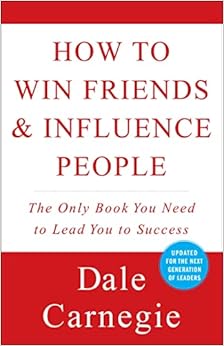
In 1-2 sentences, what is the book about as a whole?
People want to develop the social skills that lead to others acting charitably and agreeably toward them, but they are not taught in schools. This book compiles a set of key concepts that collectively work to foster positive and rewarding relationships with others, especially during potentially hostile engagements.
What are the 3-4 central questions it tries to answer?
How should you interact with other people to elicit positive responses?
How can you get people to like you?
How can you get people to agree with your way of thinking?
How can you get others to change and be happy about it?
Summarize the answers in one paragraph each.
How should you interact with other people to elicit positive responses?
Absolutely nobody likes being criticized or condemned. When we experience this, humans by nature raise our defenses and close ourselves off to the speaker. To get a positive reaction from others, the first and foremost advice is to avoid finding something wrong in others (criticism) or deeming something is bad about others (condemnation). Instead, lavish them with honest and sincere praise and appreciation. Go out of your way to notice and comment on positive aspects of the person or their work. Finally, consider what the other person wants rather than what you want. The author’s analogy here is to fishing: he baits the hook with worms (that fish like) not strawberries and cream (that he likes).
How can you get people to like you?
There are six specific suggestions to make people like you. Most can be grouped into a focus on the other person.
- Smile
- Learn and use their names
- Be interested in them
- Listen to them and encourage them to talk about themselves
- Talk in terms of their interests
- Make them feel important
The author’s business teaches these principals and more in schools across the country. The book is filled to the brim with student’s anecdotes about how this advice led to relationships that immediately yielded fruits for the student.
How can you get people to agree with your way of thinking?
The book is sorted into very deliberate chapters with one lesson each.
- Arguing doesn’t work, so avoid arguments — especially ones that you win. It’s good for your ego at the expense of your objective.
- Don’t say “you’re wrong” with words, looks, or body language. Don’t let anyone know you’re trying to prove something either.
- If you’re wrong, quickly and emphatically admit it and you will gain good will. Don’t wait for someone to come at you on the offensive.
- Begin the conversation with a drop of honey. Do not come out swinging or with aggression.
- Find and establish as much common ground as possible. Get the other person to say yes, yes and avoid a person saying no.
- Let the other person do the talking and don’t interrupt, even if you disagree with something. Encourage them to express their ideas fully.
- Let the other person feel that the idea is his or hers. Make suggestions and let the other person think out the conclusions.
- Try honestly to see the other person’s point of view and put yourself in his place.
- Be sympathetic with the other person’s ideas and desires. “If I were you I would undoubtedly feel just as you do.”
- Highlight the nobler version of others to encourage them to act accordingly. “I knew right away you were a man of your word.”
- Dramatize your ideas with showmanship. A big dramatic show or act can get a point across that a logical argument would struggle to. The example is of a newspaper who published a days worth of news as a 300-something page book to combat rumors that it had become bloated with ads.
- Last ditch effort: throw down a challenge. The example showed how Charles Schwab of Carnegie Steel created a spirit of competition between night/day shifts by simply writing their output on the ground with chalk.
How can you get others to change and be happy about it?
Sometimes as a leader you need others to improve their work. Here, too, being direct with criticism of shortcomings poses a challenge, as it can offend or arouse resentment. So Carnegie counsels to approach indirectly.
- Begin with praise and honest appreciation. “A barber lathers a man before he shaves him.”
- Call attention to people’s mistakes indirectly. The example is of Charles Schwab giving cigars to workers to “smoke outside” rather than pointing to the No Smoking sign above their heads.
- Talk about your own mistakes before criticizing the other person. It’s easier to listen to your faults after the speaker begins by pointing out their own faults.
- Ask questions instead of giving direct orders. Give people the opportunity to do things themselves, and they’ll feel better about themselves.
- Let the other person save face. Avoid criticism in public that harms people’s egos.
- Lavish praise at even the slightest improvement. “Praise is like sunlight to the warm human spirit.”
- Give the other person a fine reputation to live up to. “Your work has not lived up to your own old standards.”
- Make the fault seem easy to correct. Minimizing errors and praising the things someone is doing correct encourages others to keep going.
- Make the other person happy about doing the thing you suggest. Deliver unfavorable news with context that makes it easier to accept. For example, you weren’t selected because we need someone less popular.
What are the most important things you have learned personally?
I write this on the verge of 38 years of life. In too many ways, my past behaviors were the antithesis of this book. I am all-too adept at arguing, finding fault, criticizing and complaining. Thanks to Carnegie’s book, I now see myself promoting my ego over my ambitions all too often. As I made progress reading, I endeavored to close the gap between my actions and those proscribed by the author. I’ll be lavish in my praise, hearty in my approbation, sincere in my appreciation, and eager to listen to others talk about themselves and their interests. Above all I’ll avoid arguing, criticizing or complaining!